

What is IRDAI? Full Form, Role & Policyholder Rights
Understand the role of IRDAI in India's insurance sector. Learn about policyholder rights, the Bima Bharosa complaint system, and IRDAI vs insurer roles.
IRDAI Abbreviation: IRDAI stands for the Insurance Regulatory and Development Authority of India.
Understanding IRDAI
Let’s understand IRDAI with a real-life scenario here, wherein we have to buy an insurance policy for whatsoever reasons that can be health, life, term, or may be a motor insurance policy, we rely on a simple promise made i.e. you pay your percentages today and the insurance company will do the rest which is providing the coverage during an emergency situation. But who ensures that the insurance companies will keep their promises. That is where IRDA comes in.
It is a top tier legal body that oversees, regulates, and develops the entire insurance sector in India. Parliament created IRDAI through the IRDA Act of 1999 to ensure that insurance companies operate fairly, stay financially healthy, and prioritize customer interests. Headquartered in Hyderabad, it works directly under the Ministry of Finance.
Insurance plays an important role in protecting people & their businesses from financial risks and crises. And a policyholder is a person or group that owns some kind of insurance contract. They buy the plan from an insurance company and pay the cost which is called a premium. Now, these policy holders also need protection from unfair practices, misinformation, and poor service.
What Does IRDAI Do?
IRDAI performs several important functions to keep the Insurance sector safe, sound, fair and well regulated.Majorly protecting everyday consumers and growing the national Insurance Market.
Regulates Insurance Companies
IRDAI registers and regulates Insurance companies operating in our company. Also, it can grant, renew, modify, suspend or cancel an insurer’s registration under the respective law.
Protecting Policyholders
Ensuring that policyholders are treated fairly and that their claims are settled fairly and swiftly.
Licensing & Regulation
Granting, reinstating, modifying, or revoking the registration certificates for insurance companies, agents, brokers, and mediators.
Financial Security
Setting capital, solvency, and reserve requirements to ensure insurance companies remain financially capable of paying future claims.
Product Regulation
Reviewing and approving insurance products, premium rates, terms, and conditions offered by insurers to prevent unfair pricing or predatory terms.
Market Conduct & Fair Play
Standardizing rules to prevent misselling, deceitful practices, and anti-competitive behaviour.
Promoting Growth
Encouraging rural and social sector coverage to bring insurance access to under-represented populations.
What are Policyholder Rights?
A policyholder must be thoroughly informed about all the in & outs and also should understand their rights before buying an insurance policy. Some of the Key Pointers Include:
Right to Clear Information
One should receive all the important information about the policy including its terms& conditions, benefits, exclusions, and all other relevant details. Make sure to read the policy document carefully before accepting it.
Right of Fair Claim Handling
Insurers must follow all the applicable regulations and policy terms carefully when they assess and want to settle the claims. IRDAI specifically helps in claim settlement within its policyholder protection responsibilities.
Right to Raise a Valid Complaint
If someone is facing a problem with the Insurer, you have the complete right to complain. One should normally approach the company’s grievance redressal mechanism initially and if the issue is not addressed or is unresolved or maybe you are not satisfied with the given solution/response, you can further escalate the matter to IRDAI following its grievance mechanisms.
Right to Approach the Insurance Overseer
Eligible individual policyholders can also approach the Insurance supervisory body for certain disputes after approaching the insurer. The Overseer will provide an alternative dispute-resolution mechanism.
How Can You Complain Against an Insurance Company?
If your insurer has not addressed or resolved your complaints satisfactorily, IRDAI also provides the BIMA BHAROSA grievance system. You can register your complaints through this portal. IRDAI also provides grievance support through their call centres available all over.
Below mentioned is the process to register the complaints:
Contact your insurance company first.
Submit the complaint in writing along with all the supporting documents.
Wait for the insurer’s response.
If the issue is not addressed, remains unresolved or you are not dissatisfied, approach IRDAI through BIMA BHAROSA portal or its grievance channels.
For eligible disputes, you can also approach the Insurance regulatory body (Overseer).
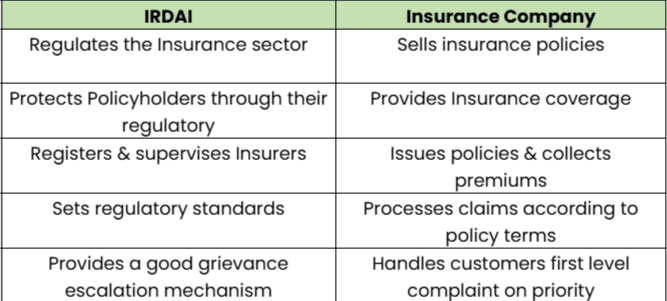
IRDAI Versus Insurance Company
It is important to understand the difference.
Conclusion
IRDAI is the legal insurance regulatory body in India. Its full form is Insurance Regulatory and Development Authority of India. It regulates insurers, protects policyholders, supervises insurance intermediaries, and promotes the orderly growth of the insurance sector.
IRDAI is important because without effective regulations, policyholders can face some problems such as misleading sales practices, unclear policy terms, poor claim handling, or inadequate grievance support. It is helping in creating a regulated environment wherein insurers should follow the rules & policy holders are having safe and swift mechanisms to raise their complaints. It also regulates the insurance sector to support its healthy and orderly development.
As a policyholder, you should know your policy terms, understand your coverage and exclusions, keep important documents safely, and raise complaints when an insurer does not provide proper service. Knowing your rights can help you make better insurance decisions and protect your financial interests.
Recommended For You
View All
OPD Cover Full Form in Health Insurance: Meaning & Benefits
Learn the OPD full form in health insurance, what OPD cover means, its benefits, coverage, claim process and key factors to check before buying.

KYC Full Form in Insurance: Rules, Documents & Process
KYC full form in insurance is Know Your Customer. Learn about KYC rules, required documents, verification process, benefits, and key requirements.

OD Full Form in Car Insurance: Coverage & Calculation
Learn the OD full form in car insurance, what Own Damage cover protects, how OD premium and claim amounts are calculated, and how OD differs from third-party insurance.